Module 4 – Google Ads / SEM
As part of Module 4 in our Digital Marketing Course, we explore one of the most common beginner questions in paid marketing: Display Ads vs Search Ads – What’s the Difference?
Both are part of the Google Ads platform, both fall under Search Engine Marketing (SEM), and both drive results. But they work differently, serve different purposes, and are useful in different situations.
In this blog by Kamlesh Singad and the CWK Agency team, we will decode both ad types in a practical, student-friendly way. By the end, you’ll know:
- How each ad type works
- When to use Search or Display
- Which campaign is right for your brand or client
- How to implement both in your marketing strategy
What Are Google Search Ads?
Search Ads are text-based ads that appear on Google Search Engine Results Pages (SERPs) when users search specific keywords.
Key Characteristics:
- Text-only format (headline + description + extensions)
- Triggered by intent-based search queries
- Appear above or below organic results
- Highly relevant to what users are looking for
Example:
User types: “Buy Smart Digital Board”
Top result: A Search Ad showing “Smart Boards – 3-Year Warranty – Order Now”
Best For:
- Capturing high-intent traffic
- Local services
- B2B & B2C lead generation
- E-commerce during purchase phase
Also Read: Best Podcast editing company in Indore – CWK Agency
What Are Google Display Ads?
Display Ads are visual ads (images, banners, GIFs, or videos) that appear across Google’s Display Network—which includes over 2 million websites, YouTube, Gmail, and mobile apps.
Key Characteristics:
- Visually engaging (image/video-rich)
- Appear outside of search (e.g., news websites, blogs)
- Triggered by demographics, interest, behavior, placements
- Excellent for awareness and retargeting
Example:
You’re reading a blog on classroom technology, and a banner ad shows:
“Get Your Digital Board Today – Flat ₹5,000 Off”
Best For:
- Brand awareness
- Product launches
- Retargeting site visitors
- Mass reach campaigns
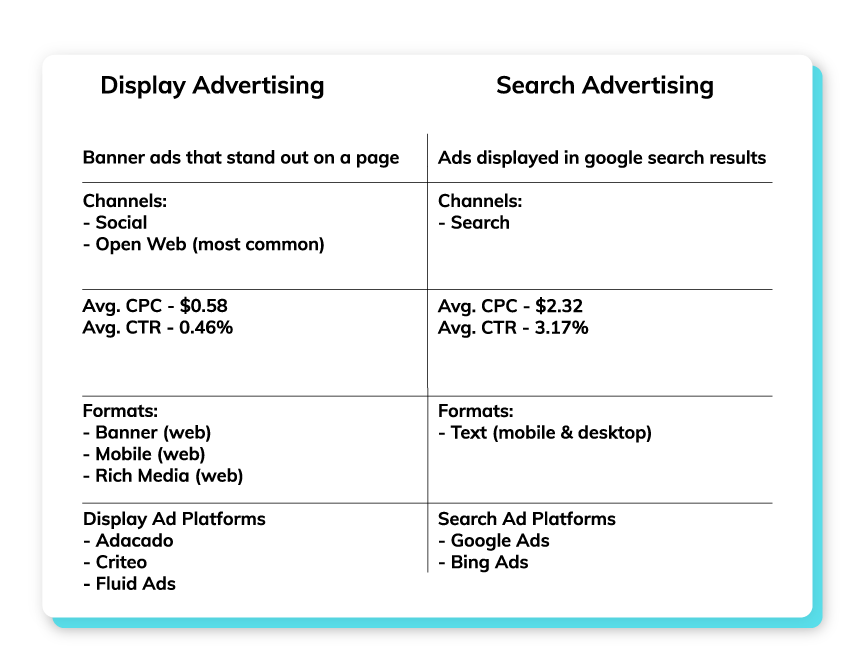
Display Ads vs Search Ads: Core Differences
| Feature | Search Ads | Display Ads |
|---|---|---|
| Placement | Google Search Results | Google Display Network |
| Ad Type | Text | Images, Banners, Videos |
| User Intent | High | Low to Moderate |
| Targeting | Keyword-based | Audience-based |
| Best For | Conversions, Leads | Awareness, Remarketing |
| CTR (Click-Through Rate) | High | Lower |
| CPC (Cost Per Click) | Higher | Generally Lower |
| Conversion Stage | Bottom of Funnel | Top/Mid Funnel |
Kamlesh Singad Tip: Use Search Ads to convert, and Display Ads to create demand.
Also Read: How ChatGPT Works: A 6-Minute Guide to Understanding ChatGPT for Beginners

Real-Life Scenario: CWK Agency Strategy
Let’s say you’re promoting studio setups for online teachers.
First Use Display Ads:
- Target YouTubers, educators, and creators
- Show banners with “Build Your Dream Studio – Affordable Packages”
- Drive traffic to landing page
Then Use Search Ads:
- When users now Google “Online teaching studio setup,” your Search Ad shows up
- Capture high-intent clicks
- Close the sale
This funnel strategy combines awareness + intent and is the exact framework used by CWK Agency for hundreds of clients.
When to Use Display Ads
✔ You’re launching a new product or service
✔ You want to reach a broad audience
✔ You’re targeting specific demographics or interests
✔ You want visual storytelling (graphics, offers, branding)
✔ You’re doing retargeting campaigns
Tips for Effective Display Ads:
- Use high-resolution images
- Keep text minimal and bold
- Add strong CTA: “Shop Now”, “Get Demo”, “Download”
- Target by interests, in-market segments, and custom intent
Also Read: DevOps and Cloud Computing Explained in 10 Minutes: A Quick Introduction to Modern IT Practices

When to Use Search Ads
✔ You’re targeting users with active purchase intent
✔ You want fast lead generation
✔ You have limited budget and need high ROI
✔ Your product/service is urgent or time-sensitive
✔ You offer local services (e.g., “Best Digital Board Dealer in Pune”)
Tips for Effective Search Ads:
- Use exact match or phrase match keywords
- Optimize ad headlines with numbers and benefits
- Link to highly relevant landing pages
- Track conversions with Google Analytics
Which One Is Better?
It’s not about Search vs Display — it’s about how you combine both.
| Goal | Best Option |
|---|---|
| Increase Website Traffic | Display |
| Generate High-Quality Leads | Search |
| Build Brand Awareness | Display |
| Immediate Sales | Search |
| Retarget Interested Visitors | Display |
| Promote YouTube Video | Display (YouTube) |
| Promote Local Service | Search |
Combine both for full-funnel success. CWK Agency always runs at least one Search and one Display campaign per client.
How to Set Up Both in Google Ads
For Search Ads:
- Go to Google Ads > New Campaign
- Choose “Leads” or “Website Traffic”
- Select Search
- Add keywords, write ad copy, set budget, and launch
For Display Ads:
- Choose “Brand Awareness” or “Product Consideration”
- Select Display
- Upload visuals, set targeting (age, interest, device), set budget
Practical Exercise for Students
Assignment: Run a dual campaign strategy
- Set up a Display Ad campaign with banners for an imaginary product
- Set up a Search Ad campaign targeting keywords related to that product
- Track both for 5–7 days
- Submit a report showing:
- Impressions
- CTR
- Cost per click
- Conversions (if any)
CWK Agency mentors will provide personalized feedback and optimization tips.
FAQs
Q1: Are Display Ads cheaper than Search Ads?
Yes. Generally, CPC for Display Ads is lower, but conversion rate may also be lower.
Q2: Can I use both types at once?
Absolutely! In fact, using both boosts overall effectiveness.
Q3: Do I need a different landing page for each?
You can use the same, but for better performance, tailor landing pages to the ad type.
Q4: Are Display Ads only for big brands?
No. Even small businesses can use Display Ads effectively for retargeting and awareness.
Final Words from Kamlesh Singad
“A skilled marketer doesn’t choose between Search and Display—they master both. At CWK Agency, we believe in giving students the full stack to win in Google Ads.”
Now that you understand the difference between Display Ads and Search Ads, your next step is to experiment. Run, test, learn, optimize. That’s how marketers are made.