Tag: Interview Preparation

  • How to Get a Job at Google: Complete Guide with Skills, Process & Examples

    How to Get a Job at Google: Complete Guide with Skills, Process & Examples


    Looking to land a Job at Google? Discover the complete guide with required skills, eligibility, hiring process, resume tips, and proven strategies to increase your chances of getting selected at Google.

    Google, the tech giant that revolutionized the way we search and access information on the internet, is a dream destination for many aspiring professionals. Whether you’re interested in working as a software engineer, data scientist, marketing specialist, or any other role, this blog will provide you with a detailed guide on how to get into it. We’ll explore the complete process, including opportunities and real-life examples to inspire your journey.

    1: Research and Self-Assessment

    Understand Google’s Culture and Values To succeed at Google, it’s crucial to align with the company’s culture and values. It’s values innovation, collaboration, and a passion for solving complex problems. Research Google’s mission statement and company culture to ensure you’re a good fit.

    Self-Assessment and Skill Evaluation Determine your strengths and weaknesses. Identify the role at Google that matches your skills and interests. It’s offers a wide range of opportunities, from engineering to marketing to design.

    2: Education and Skill Development

    Pursue Relevant Education Google values candidates with strong educational backgrounds. Pursue a degree in computer science, engineering, business, or a related field. Many employees hold advanced degrees such as Master’s or Ph.D.

    Gain Practical Experience Internships, co-ops, and relevant work experience are invaluable. They offers various internship programs like the Google Internship for Software Engineering (Google STEP). These opportunities provide hands-on experience and networking opportunities.
    Job at Google

    3: Building Your Resume

    Craft an Outstanding Resume Your resume is your first impression. Highlight your achievements, skills, and any relevant projects. Use action verbs and quantify your accomplishments. For example:

    “Developed a machine learning model that reduced customer support response times by 30%.”

    4: Preparing for Interviews

    Practice for Technical Interviews Google is known for its challenging technical interviews. Practice coding problems on platforms like LeetCode and HackerRank. Google’s own platform, Coding Competitions, is an excellent resource.

    Behavioral Interview Preparation Be ready to answer behavioral questions that assess your problem-solving, teamwork, and leadership skills. Use the STAR (Situation, Task, Action, Result) method to structure your responses.

    5: Applying for Google

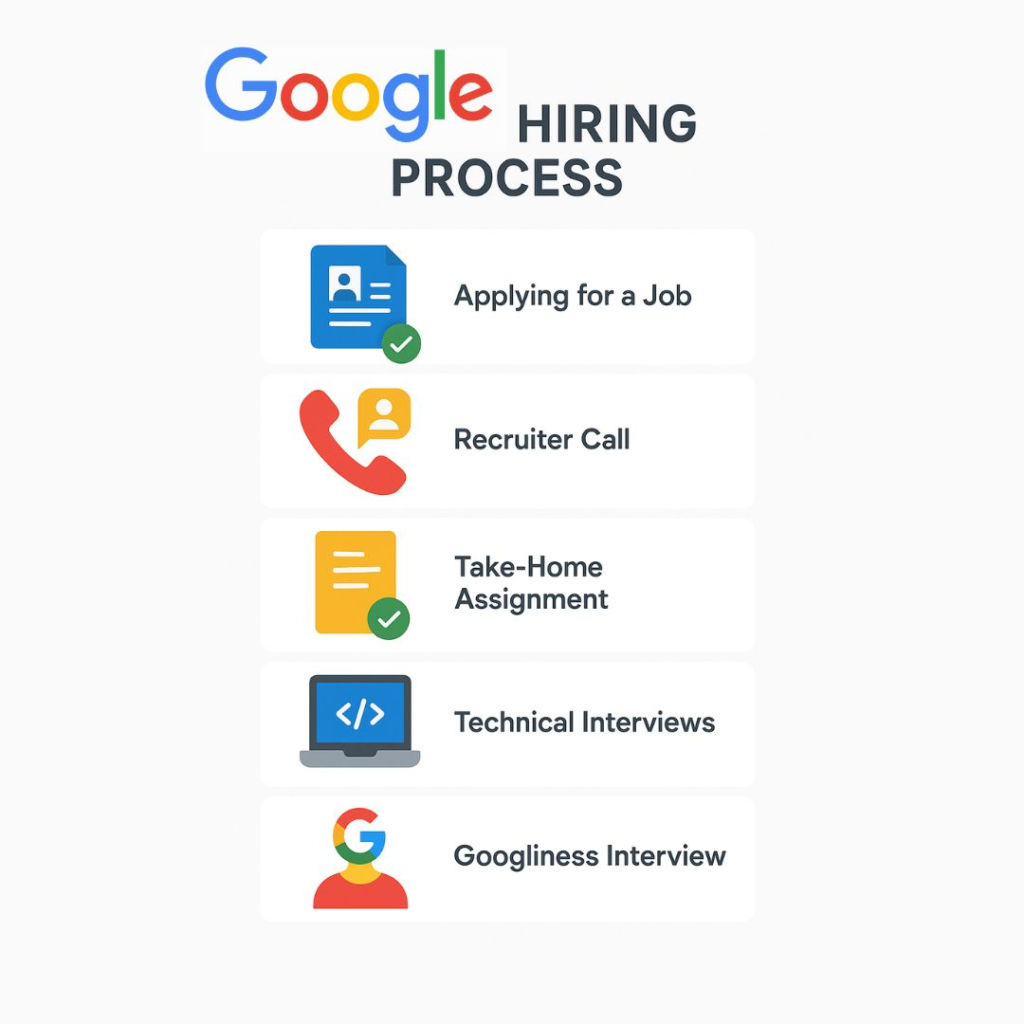
    Online Application Visit Google’s Careers website and search for job openings. Submit your resume and cover letter. Tailor your application to the specific role you’re applying for.

    Networking Leverage your network. Connect with current or former employees on LinkedIn. Attend industry conferences and Google-sponsored events to make connections.

    6: Interviewing at Google

    Phone Screen and Technical Interviews If your application is shortlisted, you’ll likely have a phone screen followed by multiple technical interviews. Prepare thoroughly and demonstrate your problem-solving skills.

    On-Site Interviews For some roles, they may invite you for on-site interviews. These often include additional technical and behavioral interviews. Be sure to practice, stay confident, and be yourself.
    Job at Google

    7: Real-Life Examples

    Let’s look at two real-life examples of individuals who successfully landed jobs at Google:

    Example 1: Jane’s Journey to Google

    Jane, a computer science graduate, spent her summers interning at startups and tech companies. She excelled in coding competitions and had a strong GitHub portfolio. After applying for multiple positions and practicing intensively for technical interviews, she secured a software engineering role.

    Example 2: Mark’s Transition to Google

    Mark had a background in marketing and several years of experience in the field. He completed Google’s Digital Marketing Certificate on Coursera to gain relevant skills. He then applied for a marketing position and highlighted his newfound knowledge. His determination and skills earned him the role.

    Conclusion

    Getting into Google is challenging but not impossible. It requires dedication, continuous learning, and a genuine passion for the company’s mission and values. By following the steps outlined in this guide and learning from real-life examples, you can increase your chances of joining one of the world’s most innovative and influential tech companies. Remember, the journey is a marathon, not a sprint, so stay persistent and focused on your goals. Good luck!
    Job at Google
  • Top 50 Google Ads Interview Questions: Your Key to Success

    Top 50 Google Ads Interview Questions: Your Key to Success

    Landing your dream job in the digital marketing industry, especially in the realm of Google Ads, can be a rewarding experience. In this blog post, we’ll dive deep into the top 50 Google Ads interview questions and provide clear, simple explanations with examples to help you ace your interview on your first attempt.

    Part 1: Google Ads Basics

    • What is Google Ads, and how does it work? It operates on a pay-per-click (PPC) model where advertisers bid on keywords. The highest bidder’s ad appears first.
    • What are the different campaign types in Google Ads?
    • Search Campaigns
    • Display Campaigns
    • Video Campaigns
    • Shopping Campaigns
    • App Campaigns
    • Explain Quality Score. Quality Score measures ad and landing page quality. It impacts ad placement and cost. Higher Quality Scores lead to lower costs.
    • What is Ad Rank, and how is it determined? Ad Rank is your ad’s position in search results. It’s calculated as Bid x Quality Score.
    Google Ads Interview Questions

    Part 2: Keyword Research and Targeting

    • What are Broad Match, Phrase Match, and Exact Match keywords?
    • Broad Match: Wide range of related searches.
    • Phrase Match: Specific phrase with words before/after.
    • Exact Match: Exact keyword or close variations.
    • How can negative keywords improve ad targeting? Negative keywords exclude irrelevant searches, saving budget.
    • Explain Keyword Match Type and its impact. Match types determine how closely a search query must match a keyword. “Exact match” ensures high relevance.

    3: Ad Creation and Optimization

    • What are the essential elements of a Google Ads text ad? Headline, description, display URL.
    • What are Responsive Search Ads? Ads with multiple headlines and descriptions tested by Google’s algorithm.
    • Explain Ad Scheduling. Ad Scheduling lets you specify when ads run.
    • What are Conversion Tracking and why is it important? Conversion Tracking measures actions after ad clicks.

    4: Budgeting and Bidding Strategies

    • What is Cost Per Click (CPC)? CPC is the amount paid per ad click.
    • What is a Daily Budget? The daily maximum ad spend.
    • What is Enhanced Cost Per Click (eCPC) bidding? It automatically adjusts bids for conversions.
    • What is Target CPA bidding? Bids are adjusted to achieve a specific cost per conversion.
    • What is ROAS (Return on Ad Spend)? It measures revenue compared to ad spend.

    5: Ad Performance Analysis and Optimization

    • What is Click-Through Rate (CTR)? CTR is the percentage of users who click on an ad.
    • What is Conversion Rate? Conversion Rate measures the percentage of users who complete a desired action.
    • Explain Impression Share.
    • What is A/B testing? A/B testing involves running two versions of an ad simultaneously.
    • How can the Search Terms report optimize campaigns? It shows the actual search queries that triggered ads.

    6: Ad Campaign Management and Advanced Strategies

    • What are Dynamic Search Ads (DSA)? DSA generates ad content based on website content.
    • What is the Google Display Network (GDN)? GDN is a network of websites and apps for displaying ads.
    • Explain Remarketing and its benefits. Remarketing targets users who previously visited your website.
    • What is Google Ads Editor? Google Ads Editor is a desktop tool for campaign management.
    • How do Quality Score and Ad Rank relate to Ad Extensions? Quality Score and Ad Rank consider ad extension relevance.
    Google Ads Interview Questions

    7: Google Ads Policies and Compliance

    • What are Google Ads Policies, and why must advertisers adhere to them? Policies ensure a safe and positive user experience.
    • How can you prevent ad disapprovals? Review and adhere to Google’s advertising guidelines.
    • What is Click Fraud, and how can advertisers protect themselves? Click Fraud is malicious clicking; protection involves monitoring and prevention.
    • How can advertisers ensure GDPR compliance? GDPR compliance involves data protection and user consent.

    8: Case Studies and Real-Life Scenarios

    • Provide a case study highlighting the importance of effective keyword research. Effective research led to a 30% increase in bookings for a travel agency.
    • Share a success story where ad optimization improved ROI significantly. A/B testing increased conversion rates by 20% for an e-commerce store.
    • Discuss a scenario where negative keywords reduced ad spend. Adding “cheap” and “used” as negatives reduced spend by 15%.
    • Share an example of effective ad scheduling targeting a specific audience. Ad scheduling increased dine-in reservations by 25% for a restaurant.
    • Describe a case where remarketing boosted conversions. Remarketing increased cart recoveries by 30% for an e-commerce store.

    9: Advanced Google Ads Topics

    • What are Google Ads Scripts and how can they automate tasks? Google Ads Scripts automate bid adjustments, reporting, and more.
    • Explain Attribution Modeling in Google Ads. Attribution Modeling assigns value to touchpoints in the customer journey.
    • What are Google Ads Custom Audiences, and how are they created? Custom Audiences target specific user groups based on behavior.
    • How can ad personalization be achieved using Google Ads Scripts? Scripts can personalize ad content based on user behavior.
    • What is Smart Bidding, and how does it work? Smart Bidding uses machine learning to optimize bids for conversions.

    10: Preparing for Your Google Ads Interview

    • How can you stay updated with Google Ads trends and updates? Follow official blog and industry newsletters.
    • What are common interview mistakes to avoid? Avoid not understanding basics, not providing clear examples, and being overly theoretical.
    • How can you showcase problem-solving skills in an interview? Discuss real challenges faced in campaigns, analysis, and optimization.
    • What is the significance of soft skills in an interview? Soft skills like communication and adaptability are vital.

    Conclusion

    Acing a Google Ads interview on your first attempt requires a solid understanding of fundamentals, advanced concepts, and practical experience. Best of luck with your interview, and may your digital marketing career reach new heights!

    Google Ads Interview Questions